Leilão Bidspirit | Madrilenian anonymous c. 1650-1700
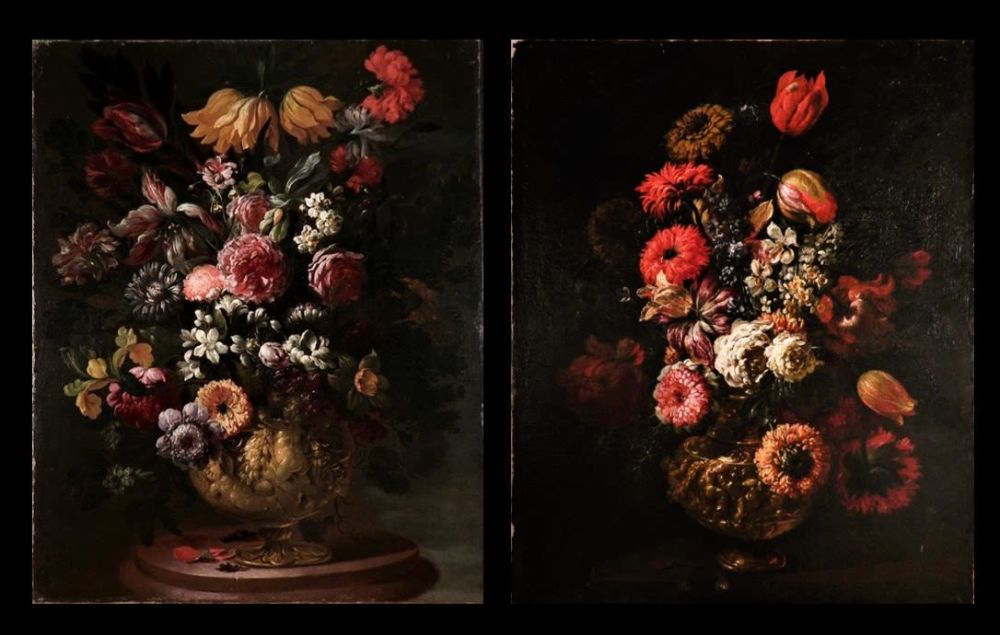
Madrilenian anonymous c. 1650-1700 - Pair of Vases. Oil on canvas. Measurements: 66 x 53 cm and 67 x 55 cm. Provenance: United States of America, private collection. Pair of still lifes of flowers in vertical rectangular format. The first painting shows a circular base on which a spherical glass of bronze aspect is presented where in its visible side two figures of children or putti are observed next to vegetable elements, decoration all figured in high relief. This vase receives a floral variety composed of tulips, carnations, roses, daffodils and orchids, among other species, surrounded by a greenish vegetal background. These paintings must have been conceived and executed in the Madrid environment of the time of kings Philip IV and Charles II, possibly painted in the second half of the seventeenth century. In those years, the maximum representatives of the genre of flower painting in Madrid were Juan de Arellano (1614-1676), Bartolomé Perez de la Dehesa (ca. 1634-1698), Gabriel de la Corte (1648-1694) and Francisco Pérez Sierra (ca. 1627-1709). We think that these works could have been made by Bartolomé Pérez or by Gabriel de la Corte, once we have studied and contrasted safe natural paintings of these two masters, in comparison with the ones we present here. We believe that there may be compositional elements and effects of pictorial quality that come from or are simultaneous with representations of both masters, comparable to this one. Thus, safe vases of both artists that are preserved in the Museo Nacional del Prado in Madrid, present such similarities. The variety of flowers painted in the first canvas are related to others that appear in certain still lifes of this type, present in paintings of those three masters, whose comparative study would be extensive for this publication. But we do want to focus our attention on the painted cup that holds the flowers, where two children are represented, painted in the form of golden grisaille, whose purpose, besides being decorative, is to visually link and unify the cup with the group of plants. The presence of small fruits and leaves next to the children reinforces this idea of unity. In particular, Gabriel de la Corte had the continuity throughout his artistic career of representing in his still lifes of flowers containers with children painted in an ochre chromatic range. If we compare those that appear in the work we are studying - here with greater detail in their lights and shadows - with two of the six canvases preserved in the Museo Nacional del Prado, we discover the similarity both in pictorial style and in the adjustment in the model of one of the children, the one that appears vertically perched on the floral stems. This child should be compared with those represented in the Prado works of the aforementioned master, Florero (cat. P001054, 62 x 84 cm) and Florero (cat. P004093, 63 x 83 cm), both from the convent of San Felipe el Real de Madrid, in Madrid's Puerta del Sol. Bartolomé Pérez also painted this type of containers for his flowers, as in the case of the two tables also in the Museo Nacional del Prado, from the old Real Alcázar of Madrid, which he painted around 1690 for what we could call the Royal Bed of His Majesty, known as the golden bed of Charles II, an artifact now lost that was intended to cover the king's bed. In this case, one of these paintings, fortunately preserved (Florero, cat. P006397, 54 x 44 cm), shows a single child comparable to the other that appears in our work, now in a horizontal position, with a face and position that can be related to each other. The work has a mid-twentieth century attribution that points to Gabriel de la Corte as its possible author, a statement to which we must include the possibility of execution by his contemporary Bartolomé Pérez de la Dehesa.