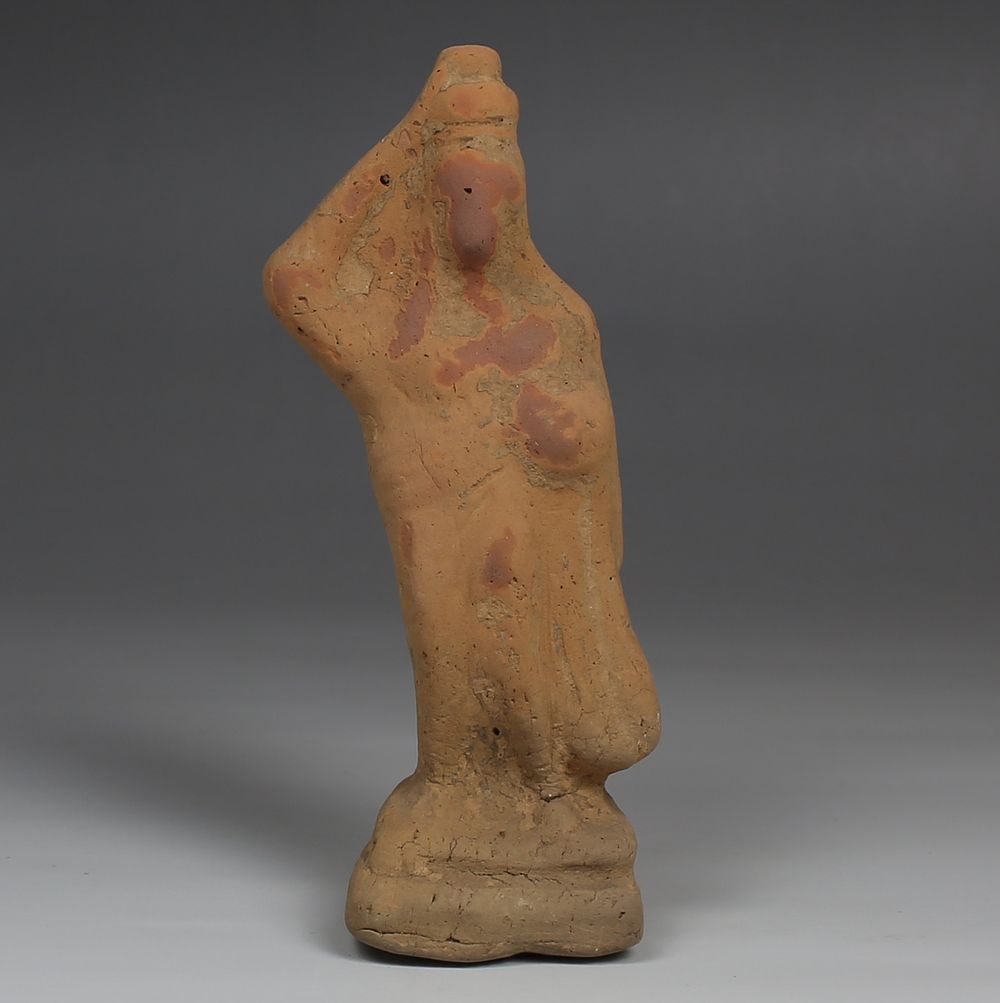
Leilão Bidspirit | Greek statuette of a water
Greek statuette of a water bearer - ITEM: Statuette of a water bearer MATERIAL: Pottery CULTURE: Greek, Hellenistic period PERIOD: 3rd - 1st Century B.C DIMENSIONS: 135 mm x 57 mm CONDITION: Good condition PROVENANCE: Ex German private collection, I.L., acquired between 1960 - 1990 Comes with Certificate of Authenticity and Export Licence. If you are from outside the European Union, we will have to apply for the export licence again for your country, this takes 3 to 5 weeks and has a cost of 5% of the hammer price, this amount will be added to the final invoice. The Hellenistic period in Greek history, spanning from the death of Alexander the Great in 323 BCE to the Roman conquest in 31 BCE, is renowned for its advancements in art and sculpture. During this era, artists sought to capture a more naturalistic and expressive style compared to the idealized forms of the Classical period. Statuettes of water bearers, also known as hydrophoroi, are a prominent example of this trend. These small-scale sculptures typically depicted young women or boys carrying water jars, often in a dynamic, lifelike pose that conveyed a sense of movement and daily activity. The water bearer statuettes are notable for their intricate detail and realism. Artists paid meticulous attention to the folds of clothing, the physical posture of the figures, and the expression on their faces, striving to depict the figures in a moment of action. The drapery of their garments was often rendered with a high degree of precision, creating a sense of lightness and fluidity. The figures' bodies were portrayed with anatomical accuracy, reflecting a deep understanding of human anatomy and movement. These statuettes served both decorative and functional purposes, often being used in domestic settings as part of household shrines or as grave offerings. The thematic choice of water bearers reflects the importance of daily life and the role of water in Hellenistic society. Water was a crucial element for both practical purposes and religious rituals, and the act of carrying water was a common, yet essential, chore. By immortalizing such mundane activities in art, Hellenistic sculptors celebrated the ordinary and elevated it to a form of artistic expression.