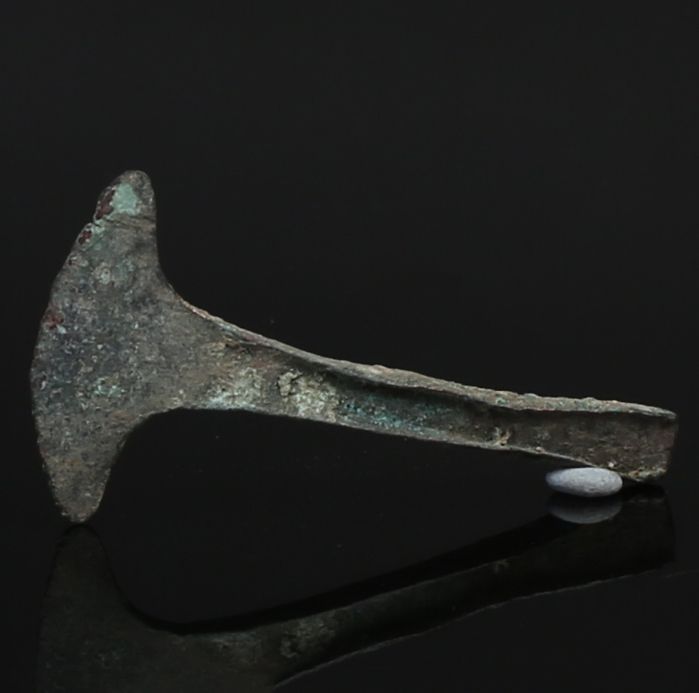
Leilão Bidspirit | Bronze Age miniature votive Palstave
Bronze Age miniature votive Palstave axehead - ITEM: Miniature votive Palstave axehead MATERIAL: Bronze CULTURE: Bronze Age PERIOD: 2nd millenium B.C DIMENSIONS: 25 mm x 45 mm CONDITION: Good condition PROVENANCE: Ex English private collection, Essex, acquired from London gallery in the 1990s Comes with Certificate of Authenticity and Export Licence. If you are from outside the European Union, we will have to apply for the export licence again for your country, this takes 3 to 5 weeks and has a cost of 5% of the hammer price, this amount will be added to the final invoice. The palstave axe head is a notable artifact from the Bronze Age, a period that spans roughly from 3300 to 1200 BCE, depending on the region. These axe heads are characterized by their distinctive design, which includes a pronounced midrib and flanges that serve to hold the wooden haft securely in place. The term ”palstave” is derived from the Old Norse word ”palstav, ” meaning ”spade, ” reflecting the tool’s elongated and often slightly curved shape. Palstave axes were primarily utilitarian tools used for woodworking, but they also had ceremonial and possibly combat uses, indicating their multifunctional role in Bronze Age societies. The design of the palstave axe head represents a significant technological advancement over earlier stone and copper axes. The midrib or central ridge running down the length of the blade provided additional strength and durability, allowing for more effective cutting and chopping. The flanges on either side of the blade helped to secure the axe head to its wooden handle more firmly, preventing it from slipping during use. This improved functionality made the palstave axe a crucial tool for Bronze Age people, facilitating the clearing of land for agriculture, the construction of wooden structures, and the production of other wooden tools and artifacts. Palstave axe heads have been found across various regions in Europe, reflecting widespread use and adaptation. The distribution of these artifacts indicates extensive trade networks and the diffusion of metallurgical knowledge during the Bronze Age. Many palstave axes are discovered in hoards, suggesting that they were valuable items often buried for safekeeping or as part of ritual offerings.