Leilão Bidspirit | Roman figure of a river
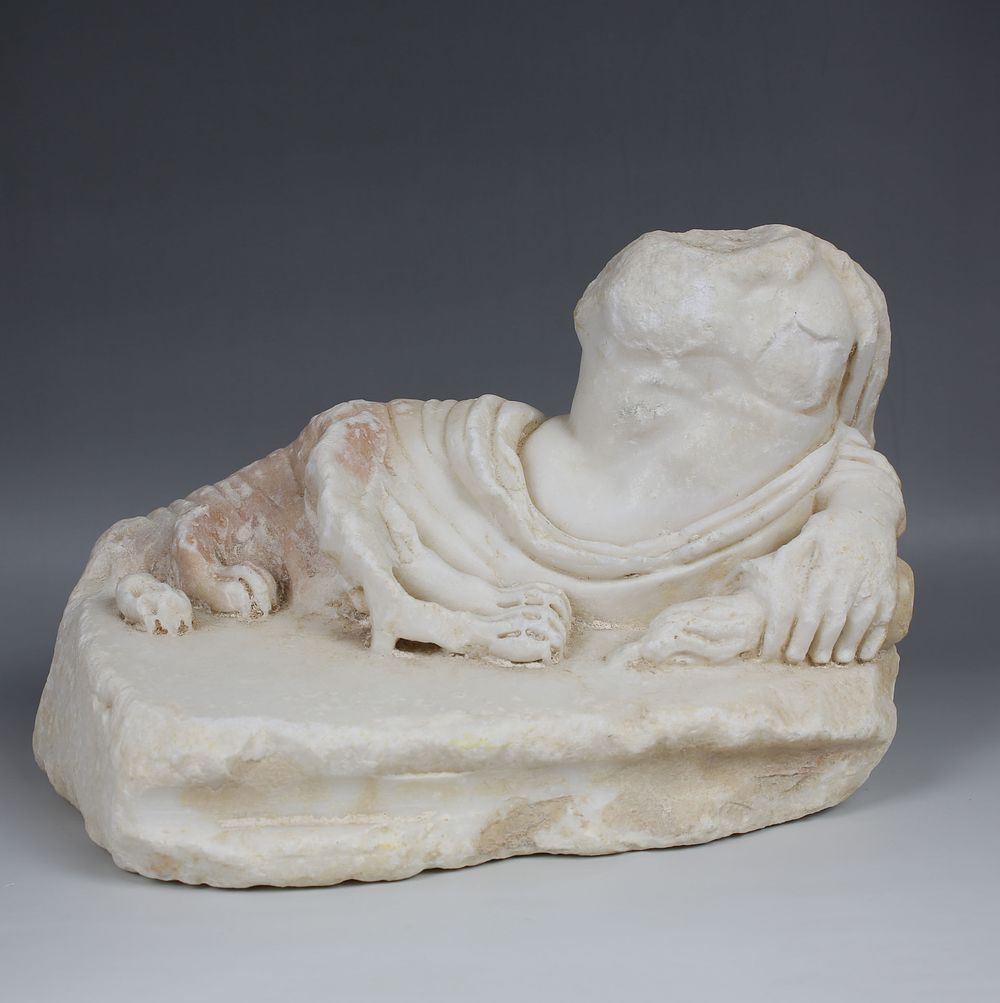
Roman figure of a river god (probably Tiber) with she-wolf - ITEM: Figure of a river god (probably Tiber) with she-wolf MATERIAL: Marble CULTURE: Roman PERIOD: 1st - 2nd Century A.D DIMENSIONS: 175 mm x 278 mm x 155 mm CONDITION: Good condition PROVENANCE: Ex European private collection, diplomatic, acquired before 1990s BIBLIOGRAPHY: Vermeule III C.C., and Comstock M.B., Sculpture in Stone and Bronze in the Museum of Fine Arts Boston, Additions to the Collection of Greek, Etruscan, and Roman Art 1971-1988, Museum of Fine Arts Boston, 1988, no. 71. PARALLEL: MVSEI VATICANI Collection, Cat. 2300 & National Archaeological Museum of Naples Comes with Certificate of Authenticity and Export Licence. If you are from outside the European Union, we will have to apply for the export licence again for your country, this takes 3 to 5 weeks and has a cost of 5% of the hammer price, this amount will be added to the final invoice. The pairing of the Roman river god Tiberinus (Father Tiber) with the she-wolf and the twins Romulus and Remus is a key motif illustrating the foundation myth of Rome. According to the legend, the twins were abandoned on the banks of the Tiber River by order of a wicked king. It was the river god, Tiberinus, who ensured their survival. The water god helped to save the infants when the basket they were placed in got stuck on the riverbank, and some sources explicitly state he saved them before they were found by the she-wolf. This association links the divine power of the river, which provided safety and nourishment, directly to the miraculous preservation of the city’s future founders. The she-wolf, or Lupa, is one of the most famous symbols of Rome, representing the animal that ultimately nursed the abandoned twins in a cave known as the Lupercal until they were found by a shepherd. This moment, often represented in art by the Capitoline Wolf sculpture, is intrinsically connected to the river god Tiber because their abandonment in the river is the crucial step that leads to the wolf’s discovery and subsequent nurturing. The combined iconography of the river god, the she-wolf, and the twins tells a complete narrative of abandonment, divine rescue, and eventual foundation, emphasizing that Rome’s origins were protected by both the martial god Mars (the twins’ divine father) and the local genius of the land and water. A prominent ancient sculpture that explicitly combines these figures is the Statue of the Tiber River with Romulus and Remus, now housed in the Louvre Museum. This large marble statue depicts the river god Tiber as a typical reclining, bearded middle-aged man, holding an oar (for navigation) and a cornucopia (symbolizing the river’s nourishing properties). Crucially, tucked beneath the god’s right arm is the she-wolf suckling the twin infants, Romulus and Remus. The statue, likely dating to the Hadrianic period, was discovered in Rome in the 16th century near the site of the Temple of Isis and Serapis, where it likely decorated a fountain. Its composition visually reinforces the fundamental roles of both the Tiber river (personified as Tiberinus) and the she-wolf in the divine and miraculous beginnings of Rome.