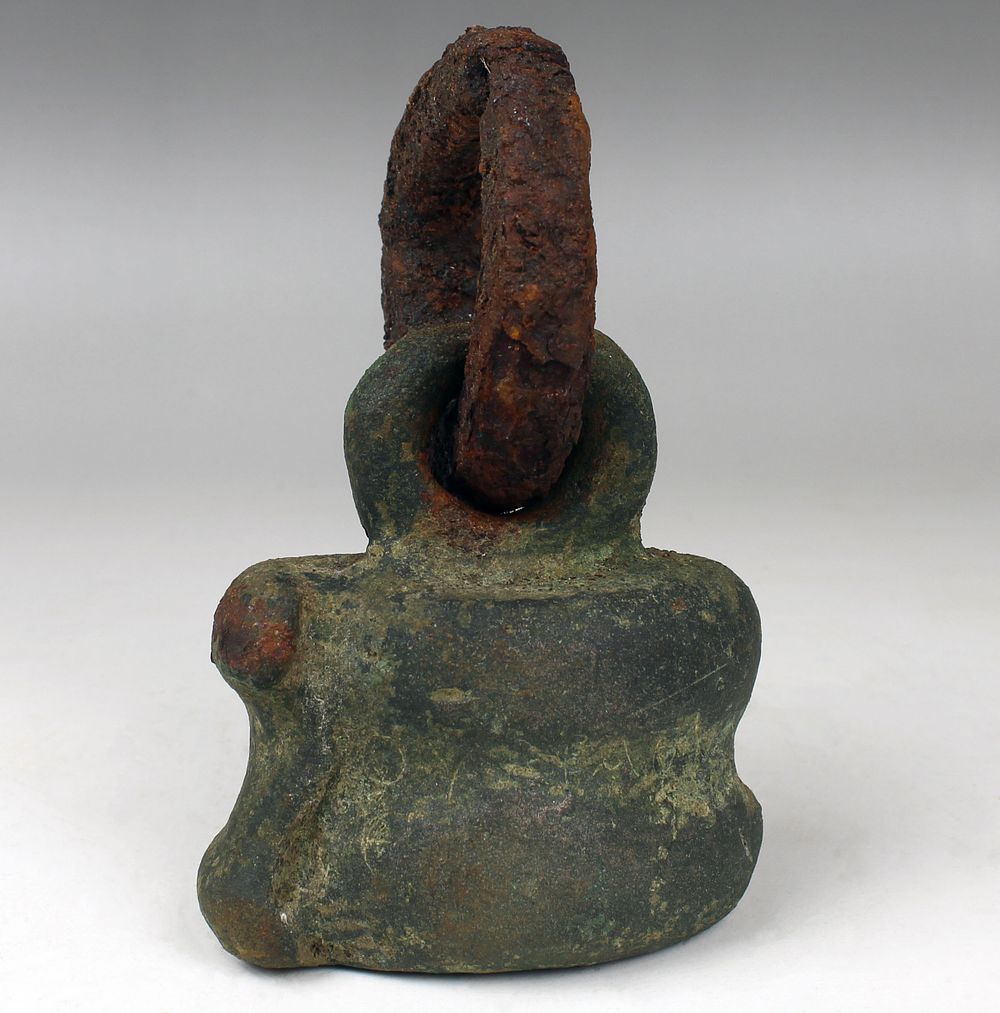
Leilão Bidspirit | Roman weight in the shape
Roman weight in the shape of an astragalus with Greek inscription - ITEM: Weight in the shape of an astragalus with Greek inscription 'ΟΥ..ΡΑTΑ' MATERIAL: Bronze and Iron CULTURE: Roman PERIOD: 3rd Century A.D DIMENSIONS: 130 mm x 84 mm, 1,5 kg CONDITION: Good condition PROVENANCE: Ex English private collection, acquired between 1970 - 1990 Comes with Certificate of Authenticity and Export Licence. If you are from outside the European Union, we will have to apply for the export licence again for your country, this takes 3 to 5 weeks and has a cost of 5% of the hammer price, this amount will be added to the final invoice. The Roman weight shaped like an astragalus, or knucklebone, is a fascinating piece of Roman material culture that bridges the gap between everyday entertainment and official commerce. The astragalus is the talus bone from the ankle of an animal, typically a sheep or goat, which was used in antiquity as an informal gaming piece, similar to dice. Roman artisans replicated this naturally asymmetrical bone in heavier materials like bronze or lead to serve a completely different, formal purpose. These metal replicas preserved the characteristic irregular, multifaceted shape of the bone, distinguishing them from the simpler, geometric weights also common in the Roman world. The primary function of these astragalus-shaped artifacts was as certified weights for trade and commerce. Roman society relied on standardized systems of weights and measures, often controlled and verified by state officials (agoranomoi) and stored in temples, such as the Temple of Ops Augusta in Rome. The metal astragalus weights are not mere curiosities; large examples, sometimes inscribed with their official weight or an indication of their regulatory authority, conform to standard Roman weight units like the libra (pound) or its fractions. Their recognizable form ensured they were understood to be part of the official Roman economy, even though the replication of a simple bone contrasts with the more elaborate busts, animals, or geometric shapes used for other bronze weights. Beyond their role in commerce, the choice of the astragalus shape likely carried a strong cultural resonance. The original knucklebones were ubiquitous across the Greco-Roman world, used not only for games of chance (tali or astragaloi) but also as symbolic votive offerings. By casting an object associated with everyday life, luck, and ritual into a certified, stable weight, the Romans incorporated a familiar symbol into their system of measurement. The metal astragalus weights, therefore, serve as a tangible link between the seemingly disparate worlds of gambling, votive gifts, and economic regulation, demonstrating a unique Roman penchant for reproducing culturally significant forms in enduring, functional materials.