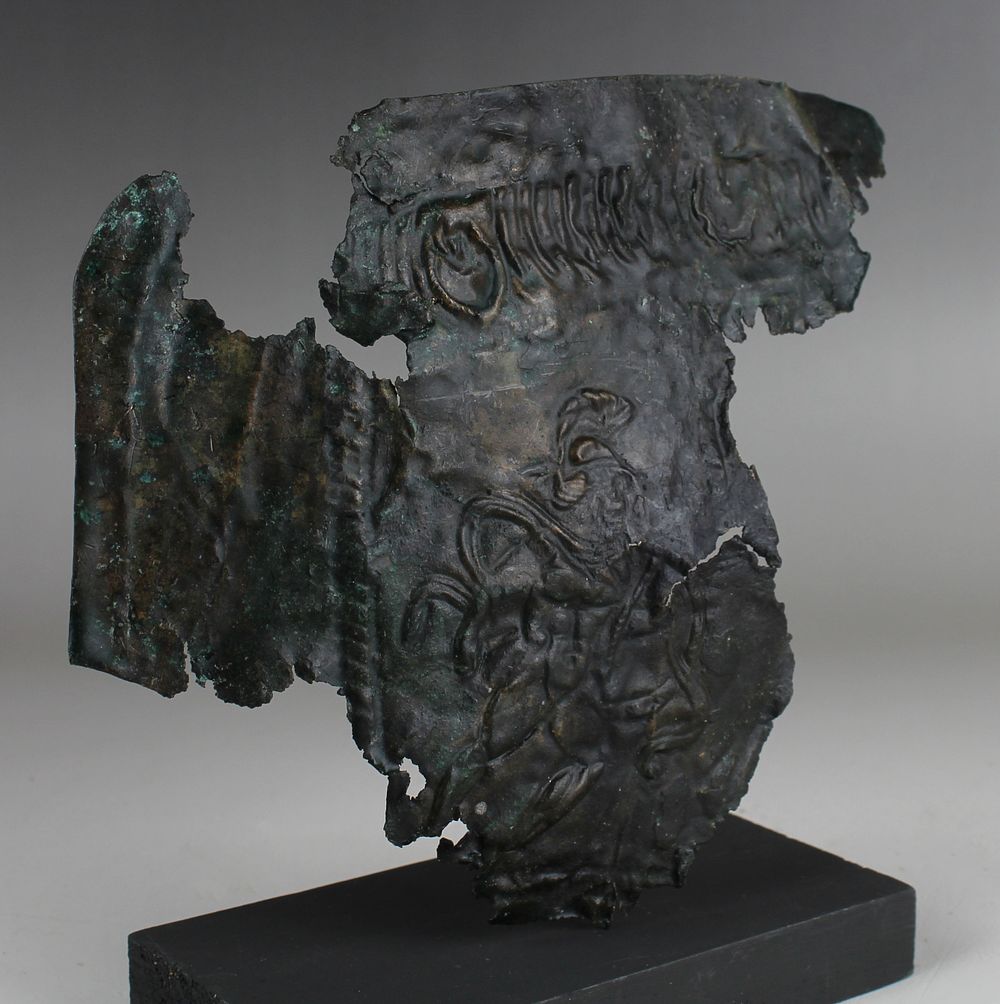
Leilão Bidspirit | Roman military mask helmet section
Roman military mask helmet section depicting Mars - ITEM: Military mask helmet section depicting Mars MATERIAL: Bronze CULTURE: Roman PERIOD: 3rd Century A.D DIMENSIONS: 150 mm x 180 mm CONDITION: Good condition. Includes a certificate of search in the stolen works of art of Interpol database PROVENANCE: Ex Alison Barker private collection, a retired London barrister, acquired between 1960s – 1990s BIBLIOGRAPHY: RUCINSKI, E., Get the picture?: Iconography of cheek pieces on Roman Imperial cavalry helmets, Journal of Roman Military Equipment Studies Comes with Certificate of Authenticity and Export Licence. If you are from outside the European Union, we will have to apply for the export licence again for your country, this takes 3 to 5 weeks and has a cost of 5% of the hammer price, this amount will be added to the final invoice. This object has been verified in the the stolen works of art of Interpol database and is accompanied by a search certificate by us. Roman military equipment is famous for its abundance of depictions rife with symbolical content. The so-called cavalry sports equipment, which used to be seen as being solely parade armour, can be distinguished from the infantry equipment not only by its function, but also by its design. There are numerous surviving heavily ornamented parts of Roman cavalry equipment and a number of studies have been published on their purpose and decoration. Whether the ornamented equipment belonged to parade armour or was also worn in battle is still under discussion. One of those groups contains the helmets, of which a relatively large number of different variations exist. Apart from the calotte with its neck guard, the loosely attached cheek pieces were also an essential part of the helmet. Cheek pieces as protective elements were used both for infantry and cavalry helmets. Although in some cases it is still difficult to attribute individual examples to the cavalry, due to the higher amount of remains we can be relatively certain that the majority of helmets did indeed belong to the cavalry. Mars was one of the most important and widely revered gods in the Roman pantheon, second only to Jupiter, and was primarily known as the god of war. However, his role extended beyond mere conflict; he was originally an agricultural deity associated with spring, growth, and the protection of cattle and fields. This dual nature reflects his essential function as a guardian of the Roman people and their territory: he was invoked to ensure a successful harvest and to protect the land from both enemy forces and natural threats. He was considered the father of Romulus and Remus, the legendary founders of Rome, solidifying his status as the divine ancestor of the Romans (Pater). Due to this ancestral connection and his aggressive military aspect, he became the core divinity of the Roman army and the embodiment of masculine virtue, courage, and martial strength (virtus). Unlike the Greeks' fickle god of war, Ares, the Roman Mars was a dignified, just, and highly ritualized figure whose worship was central to state religion and military triumph.