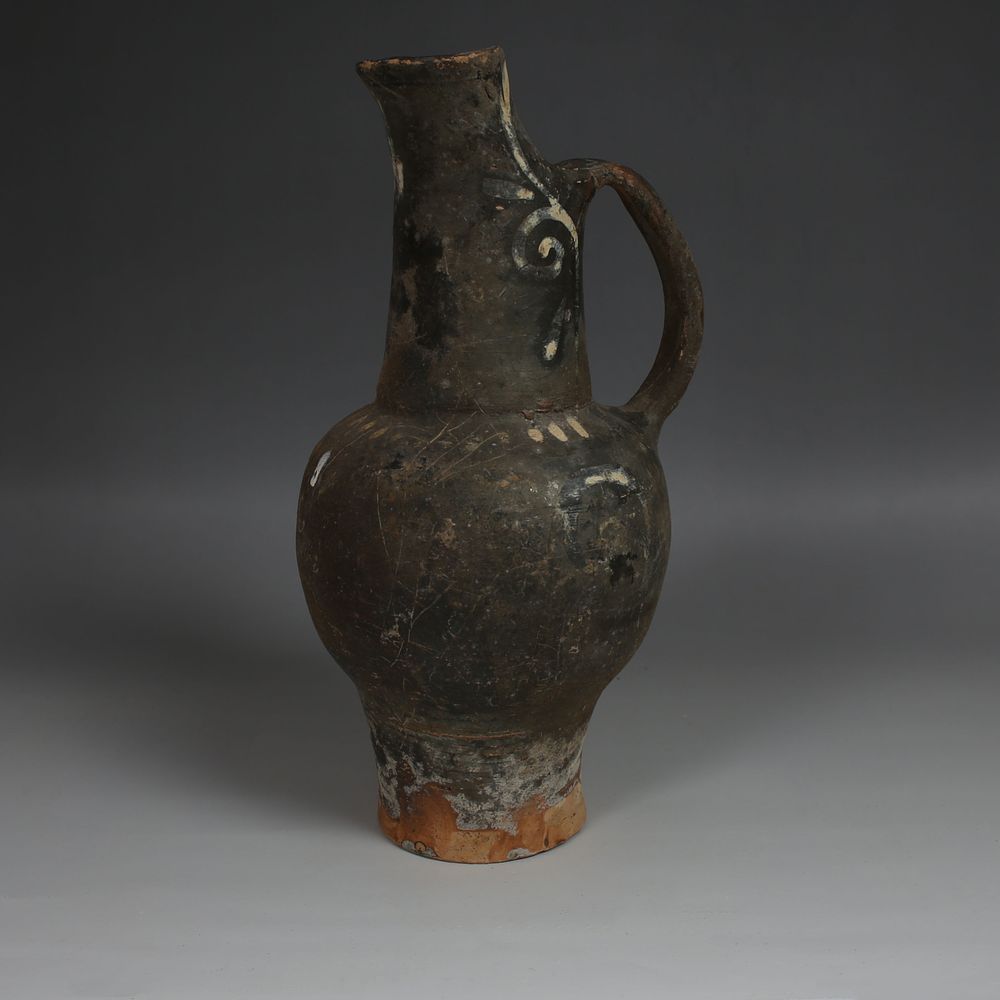
Leilão Bidspirit | Faliscian beaked jug
Faliscian beaked jug - ITEM: Beaked jug MATERIAL: Pottery CULTURE: Faliscian PERIOD: 4th Century B.C DIMENSIONS: 233 mm x 123 mm x 110 mm CONDITION: Good condition PROVENANCE: Ex Belgian private collection, Ex Spanish antiquities dealer (2022), Ex Belgian private collection, Brussels Comes with Certificate of Authenticity and Export Licence. If you are from outside the European Union, we will have to apply for the export licence again for your country, this takes 3 to 5 weeks and has a cost of 5% of the hammer price, this amount will be added to the final invoice. The Faliscans were an ancient Italic people who lived in the city of Falerii and a considerable area of surrounding territory, the ager Faliscus. They spoke an Italic language, Faliscus, which was closely related to Latin. Despite considerable Etruscan influence, the Faliscans retained, in addition to their language, many features of their Italic origin, such as the worship of Ceres, Mercury or Mars, and the cult of the god Soranus by the Hirpi Sorani. Established at least from the beginning of the first millennium BC in an area on the right bank of the river Tiber between Etruria and Latium, the Phaliscans maintained close cultural, commercial and political ties with the Etruscans from the first centuries of their history. Allies of Veyes in the wars that this city waged against Rome in the 5th century BC, which ended with the fall of the Etruscans. They remained hostile to Roman expansion until, like all the other peoples of the Italic peninsula, they were finally subjugated in the 3rd century BC. In 241 BC their last war against Rome ended not only with the loss of the last remnants of political autonomy but also with the destruction of their historic centre and main city, Falerii.