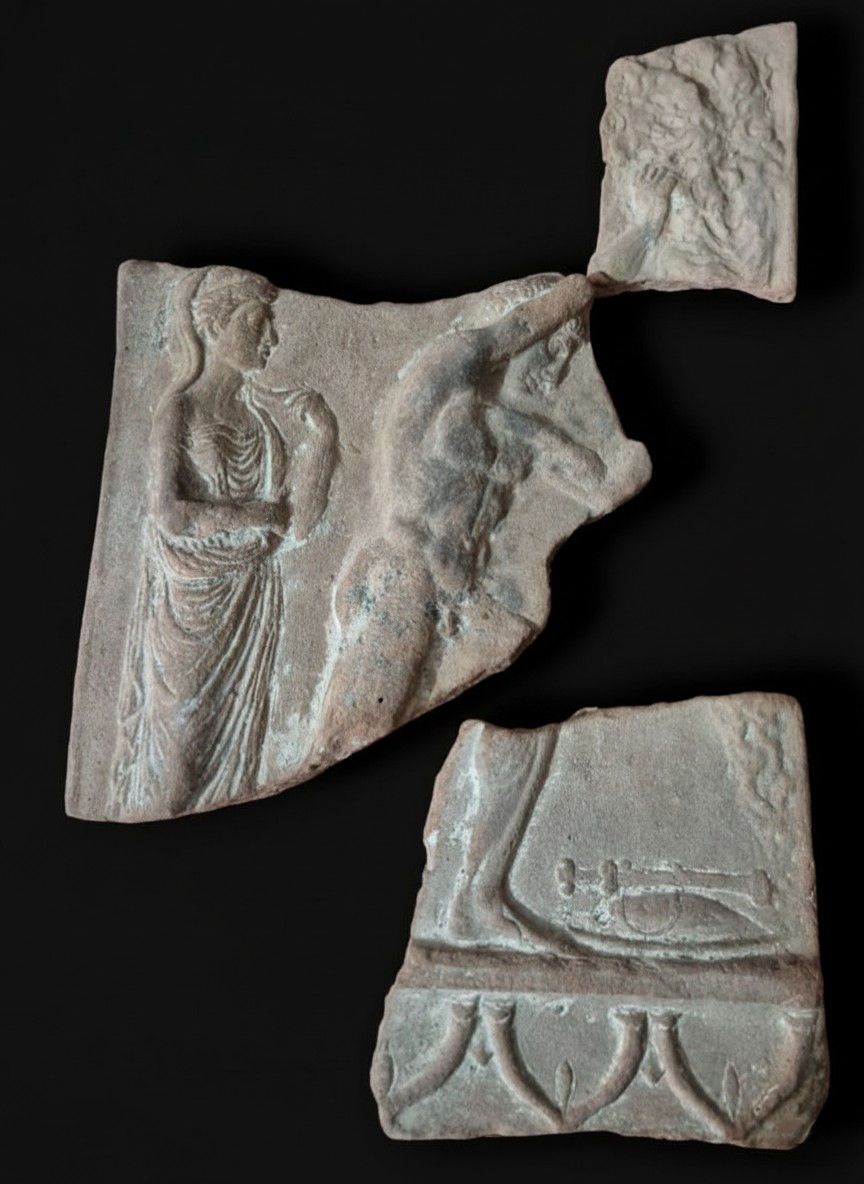
Leilão Bidspirit | Roman Campana relief
Roman Campana relief - ITEM: Campana relief MATERIAL: Pottery CULTURE: Roman PERIOD: 1st Century A.D DIMENSIONS: Overall 630 mm x 410 mm, Separate pieces 345 mm x 340 mm x 50 mm, 230 mm x 230 mm x 50 mm, 132 mm x 190 mm x 25 mm CONDITION: Good condition, fragmentary PROVENANCE: Ex European private collection, Ex Lakythos S.A.R.L (1987), Ex Galerie Hydra, Geneva, Switzerland (1984) Comes with Certificate of Authenticity and Export Licence. If you are from outside the European Union, we will have to apply for the export licence again for your country, this takes 3 to 5 weeks and has a cost of 5% of the hammer price, this amount will be added to the final invoice. The Campana Reliefs are a distinct category of ancient Roman terracotta plaques that were used extensively as architectural decoration, primarily from the mid-first century BCE to the mid-second century CE. They are named after the 19th-century Italian collector Giampietro Campana, who first cataloged and published them, drawing scholarly attention to this art form. These reliefs were created by pressing wet clay into reusable molds, allowing for mass production of detailed decorative friezes. They served as a less expensive, yet still highly detailed, alternative to carved stone reliefs and were originally brightly painted, though only traces of their vibrant colors often remain today. The tradition of using architectural terracottas dates back to the Etruscan temples, but the Campana reliefs mark their sophisticated revival and popularization during the Roman Republic and early Empire. Functionally, Campana reliefs were integral to the ornamentation of various structures, both public and private. They were typically employed as horizontal friezes on the exterior of buildings, lining the top of walls just below the roofline, or as revetment plaques to protect and adorn wooden roof elements. The plaques were produced in different forms corresponding to their architectural placement, including cladding tiles, crowning tiles, and antefixes (vertical blocks at the eaves of a roof). They have been found decorating temples, public baths, theaters, and private houses, especially in the central Italian region around Rome. This wide application speaks to their popularity and their role in standardizing decorative motifs across different classes of Roman architecture. The artistic motifs on the Campana reliefs are incredibly varied, providing a rich visual record of Roman culture and artistic tastes. The subject matter can be broadly categorized into mythological scenes, which frequently include episodes from the Homeric epics, the deeds of heroes like Heracles, and Dionysiac revelry; daily Roman life, depicting scenes from the circus, the theater, or military triumphs; and ornamental themes, such as elaborate floral or acanthus scrollwork. A notable theme is the Nilotic landscape, depicting scenes from Egypt like the Nile in flood, often featuring crocodiles, pygmies, and exotic flora. Stylistically, the plaques often reflect the Neo-Attic classicism popular during the Augustan period, blending older Greek prototypes with Roman sensibilities to create a monumental decorative statement in a relatively humble medium.