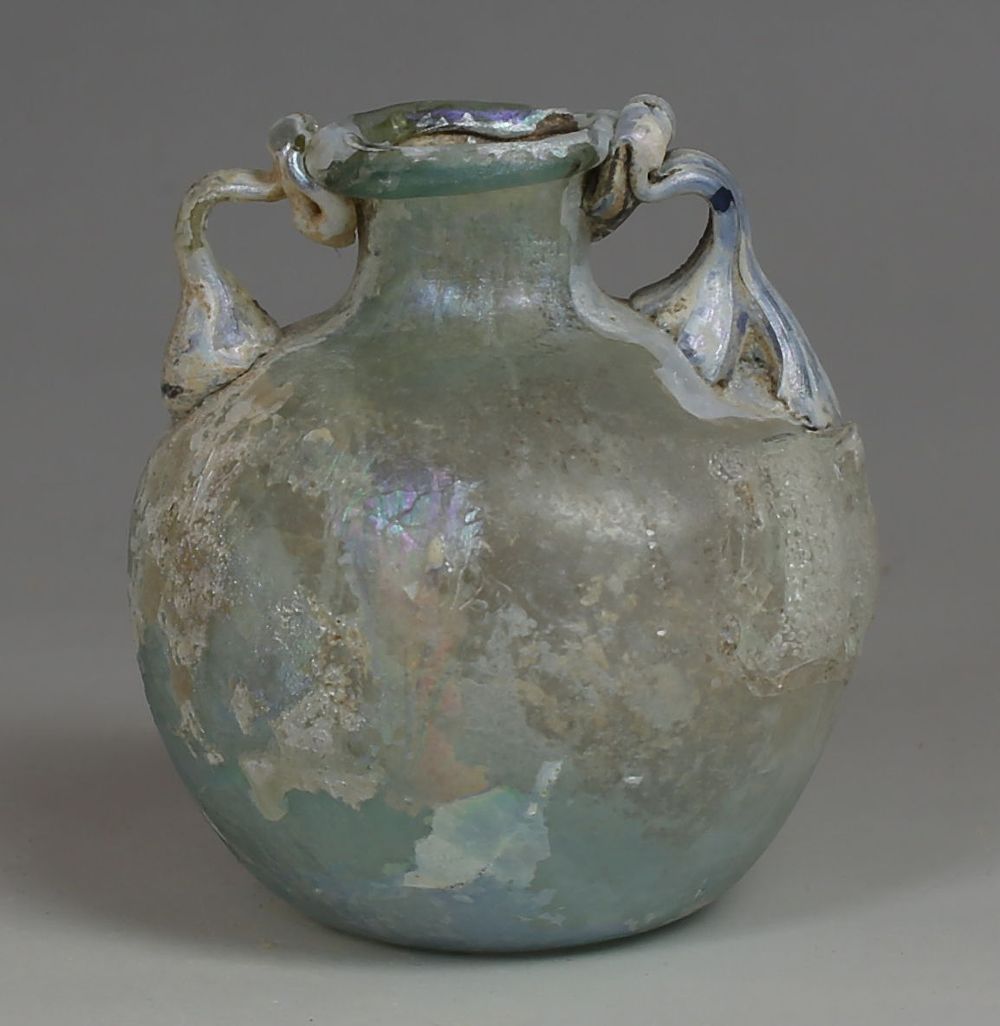
Leilão Bidspirit | Roman aryballos
Roman aryballos - ITEM: Aryballos MATERIAL: Glass CULTURE: Roman PERIOD: 1st - 3rd Century A.D DIMENSIONS: 64 mm x 58 mm CONDITION: Good condition PROVENANCE: Ex French private collection, acquired before 1990s Comes with Certificate of Authenticity and Export Licence. If you are from outside the European Union, we will have to apply for the export licence again for your country, this takes 3 to 5 weeks and has a cost of 5% of the hammer price, this amount will be added to the final invoice. The aryballos (plural aryballoi) was a small, spherical, or globular flask, a vessel type originating in Ancient Greece and later adopted throughout the Roman Empire. Its distinctive shape featured a globular body (hence the Greek name, which refers to a leather bag or sack), a short, narrow neck, and a broad, flat rim. The characteristic narrow opening was practical, allowing the user to carefully dispense small, controlled amounts of its precious contents. While earlier Greek aryballoi were typically made of ceramic (pottery), the Roman era saw the widespread production of these vessels in blown glass, a technological innovation of the 1st century CE. These glass versions were often made with a thin, translucent body and frequently featured one or two small handles, to which bronze chains or rings could be attached for carrying. The primary function of the Roman glass aryballos was as a container for expensive oils and perfumes (unguentum), essential items for the elaborate Roman bathing ritual. Visitors to the thermae (public baths) carried their aryballoi from home, often with a chain or strap allowing them to be worn on the wrist or hung in the changing rooms (apodyteria). The oils were applied to the body after sweating and before the final plunge into the cold bath (frigidarium). The oil served both to lubricate the skin and, most importantly, as a cleansing agent. After the oil was rubbed in to absorb dirt and sweat, the mixture was scraped off the body using a curved bronze tool called a strigil. For the Romans, the aryballos was thus an inseparable accoutrement of daily life and social interaction at the baths. The use of blown glass dramatically changed the production and aesthetic of the aryballos. Unlike the earlier core-formed glass vessels which were thicker and more opaque, the free-blown Roman examples are often delicate and transparent, showcasing the craftsmanship of the Roman glassmakers, particularly those in the Eastern Mediterranean centers like Syria and Palestine. These glass aryballoi frequently exhibit beautiful bluish-green or manganese purple tints and occasionally feature decorative wheel-cut bands or specialized handle shapes. Their widespread use and distinctive appearance make the Roman glass aryballos a common and recognizable archaeological find, often unearthed in Roman settlements and cemeteries across the vast territories of the empire.