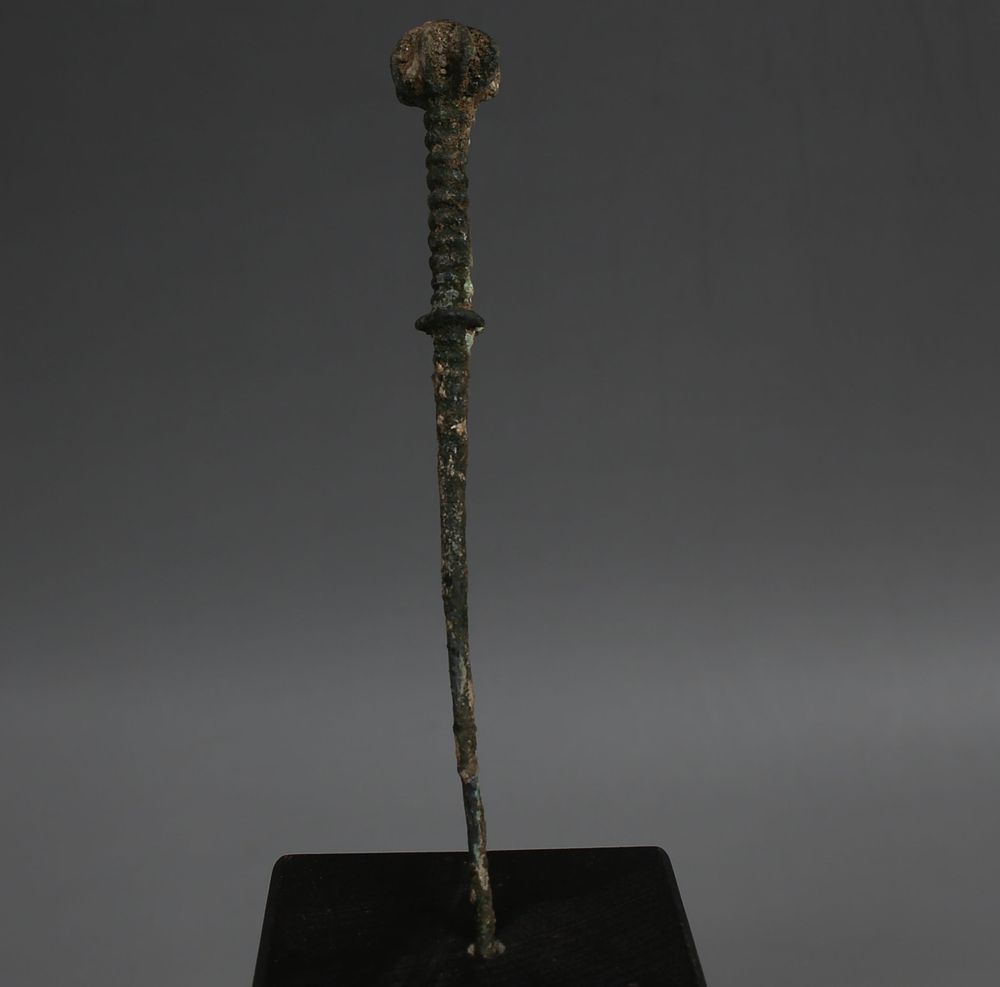
Leilão Bidspirit | Bronze Age hairpin, Ex MUSEUM
Bronze Age hairpin, Ex MUSEUM - ITEM: Hairpin MATERIAL: Bronze CULTURE: Bronze Age PERIOD: 3rd - 2nd millenium B.C DIMENSIONS: 140 mm x 16 mm CONDITION: Good condition PROVENANCE: Ex Museum für Asiatische Kunst, Ex Galerie Hardt, Germany, acquired between 1970 - 2010 Comes with Certificate of Authenticity and Export Licence. If you are from outside the European Union, we will have to apply for the export licence again for your country, this takes 3 to 5 weeks and has a cost of 5% of the hammer price, this amount will be added to the final invoice. The emergence of the Bronze Age (roughly 3300 BCE to 1200 BCE, varying by region) marked a significant shift in the production of personal adornments, including the hair pin. While earlier examples from the Neolithic period were crafted from readily available materials like bone, ivory, or wood, the mastery of metallurgy introduced copper and, subsequently, bronze as superior materials. This new alloy offered not only greater durability but also a medium for more sophisticated decoration, allowing for the creation of slender, yet robust pins. These metal pins, unlike the cruder bone predecessors, could be cast, hammered, and meticulously finished, transforming them from simple fasteners into clear indicators of the wearer's craftsmanship, wealth, and status within the emerging stratified societies of the Bronze Age. Bronze Age hair pins served a dual purpose: they were primarily functional implements for securing elaborate hairstyles—a necessary accessory given the fashion for long hair—but also important articles of personal adornment. The heads of these pins frequently bore the majority of the decoration, featuring a wide variety of shapes, from simple spherical or coiled tops to more complex geometric patterns, discs, or loops. Archaeological finds from cultures across Europe, such as the Únětice culture in Central Europe or the hoards of the British Bronze Age, show a range of forms. Furthermore, the practice of creating very long pins, sometimes over 10-20 centimeters in length, suggests that the pin was often intended to be highly visible, protruding from the hair or clothing to serve a decorative and social function. The context in which Bronze Age hair pins are found speaks volumes about their social significance. They are frequently recovered as grave goods, particularly in female burials, where their inclusion suggests they were highly valued personal possessions deemed necessary for the afterlife. In some cases, such as the Hallstatt burials (spanning the late Bronze Age into the Iron Age), exceptionally long or elaborate bronze pins are found, sometimes even in what are believed to be male graves, indicating their use may not have been strictly gendered but rather a universal symbol of status or rank. The shift to bronze, a material that required specialized knowledge and trade networks to acquire and work, cemented the hair pin's role as more than just a functional tool; it was a powerful statement of social standing, connecting the wearer to the burgeoning technology and commerce of the Bronze Age world.