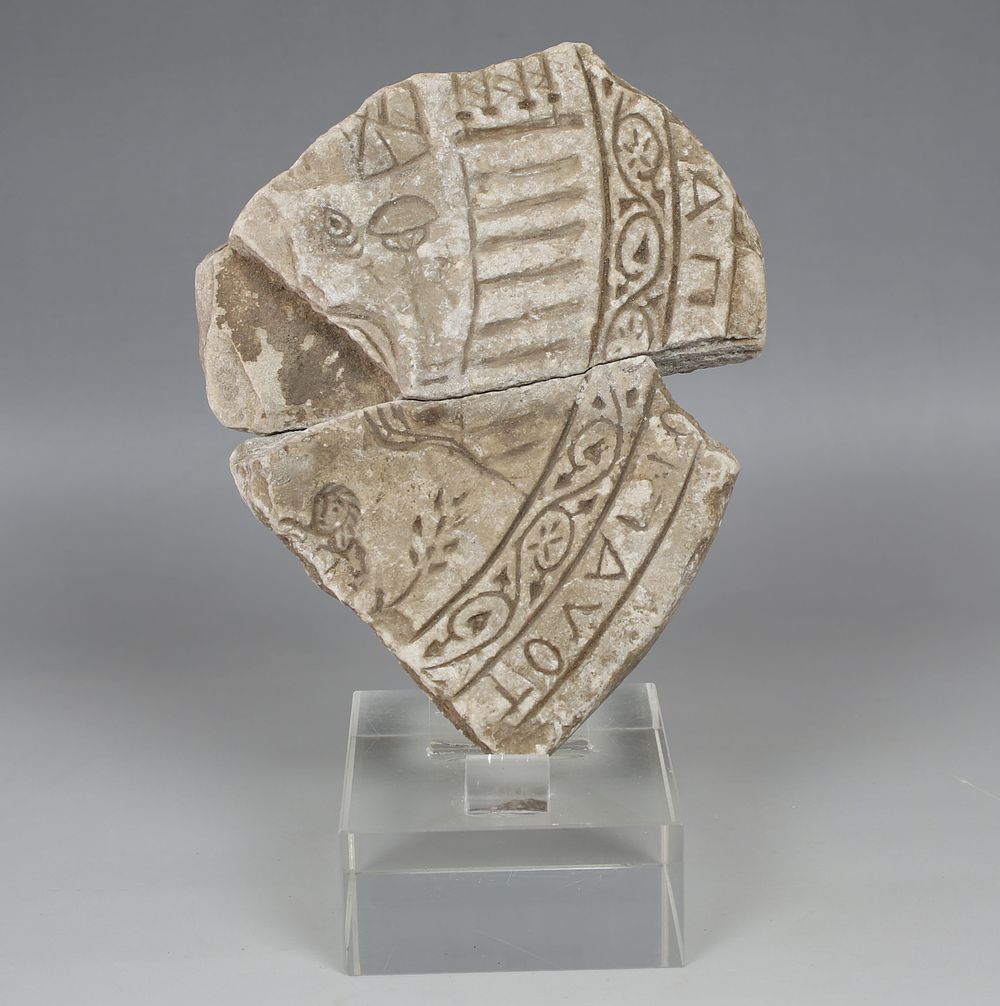
Leilão Bidspirit | Christian ceramic vessel mold with
Christian ceramic vessel mold with inscription which would refer to a holy person - ITEM: Ceramic vessel mold with inscription 'ΤΟΝ ΑΓΙΟ[.] ΠΑ[---]', which would refer to a holy person MATERIAL: Limestone CULTURE: Christian PERIOD: 5th - 6th Century A.D DIMENSIONS: 115 mm x 135 mm CONDITION: Good condition, are two separate pieces PROVENANCE: Ex American art gallery, New York, acquired from American private collection before 2000s Comes with Certificate of Authenticity and Export Licence. If you are from outside the European Union, we will have to apply for the export licence again for your country, this takes 3 to 5 weeks and has a cost of 5% of the hammer price, this amount will be added to the final invoice. The limestone mold for a ceramic vessel, particularly those bearing Christian symbols, is a significant artifact of the Late Antique and Early Byzantine periods (c. 4th–7th centuries CE), primarily found in regions like Egypt (Coptic) and Asia Minor. These molds were essential to the mass production of small, molded earthenware objects, most famously pilgrim flasks (or ampullae). Unlike common, utilitarian pottery, these vessels served a sacred purpose, functioning as religious souvenirs and containers for holy substances. Limestone, being relatively easy to carve, was used to create the negative impression for the vessel's decorative relief, often in two halves which would then be joined after the clay was pressed into them. The ceramic vessels produced from these molds are characterized by their Christian iconography, which was central to their function as eulogia (blessings). Typical motifs include scenes from the Bible, the cross, the Christogram (a monogram of Christ's name), or representations of popular saints. The most famous examples are the Menas flasks from the shrine of Saint Menas in Abu Mena, Egypt, which depict the saint flanked by two kneeling camels. These images were not merely decorative; they were believed to transfer the healing or protective power of the holy site or the saint to the oil, water, or soil they contained. The use of molds allowed for a degree of artistic standardization while meeting the high demand from pilgrims traveling to major Christian sites. The existence of these molds and the proliferation of their ceramic products highlight the commercialization of Christian piety and the changing nature of religious practice in the late Roman world. The workshops that housed these molds were often situated near pilgrimage centers and were crucial in supplying the steady stream of believers. As pilgrims dispersed across the Mediterranean and beyond, they carried these small, durable, mold-made vessels with them. This not only disseminated Christian iconography and cults but also established an early and extensive trade network for religious tokens, providing rich archaeological evidence for popular beliefs and the material culture of early Christianity.