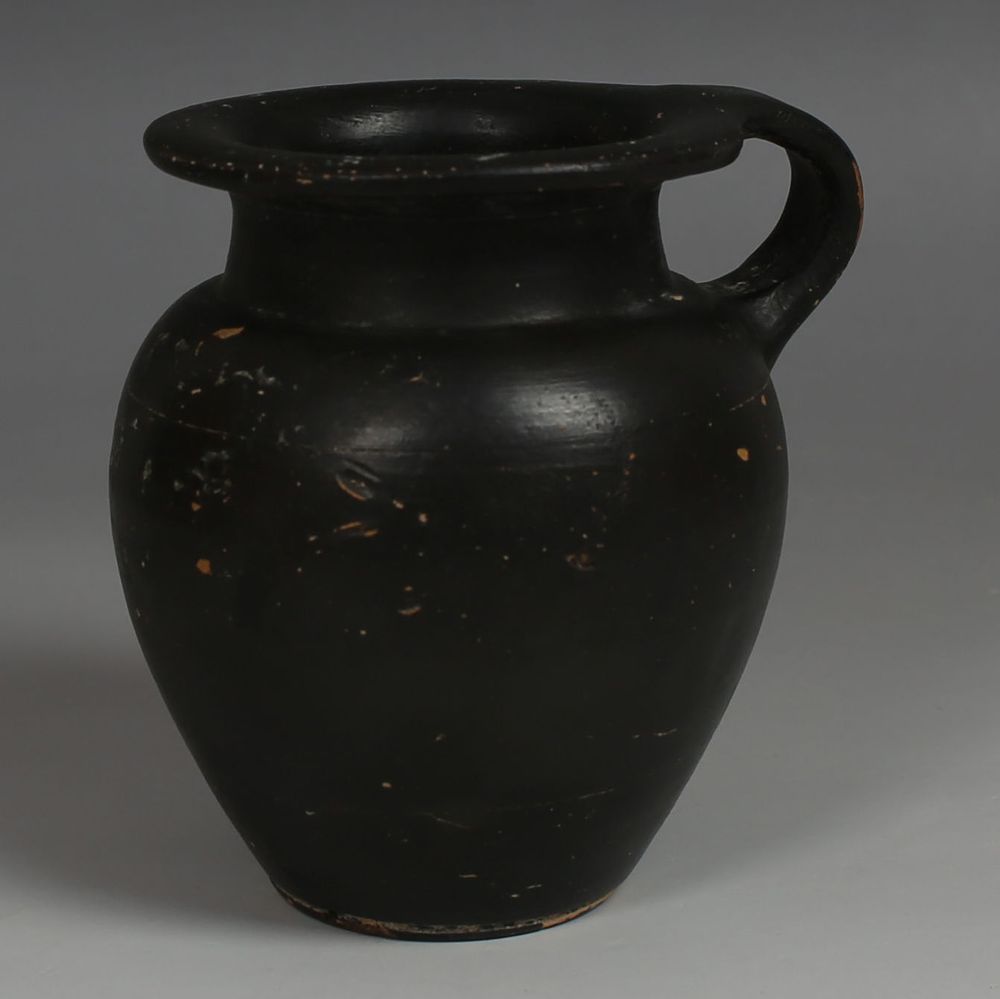
Leilão Bidspirit | Greek olpe
Greek olpe - ITEM: Olpe MATERIAL: Pottery CULTURE: Greek PERIOD: 4th Century B.C DIMENSIONS: 82 mm x 77 mm x 78 mm CONDITION: Good condition PROVENANCE: Ex German private collection acquired in 1986 from P.L., Paris Comes with Certificate of Authenticity and Export Licence. If you are from outside the European Union, we will have to apply for the export licence again for your country, this takes 3 to 5 weeks and has a cost of 5% of the hammer price, this amount will be added to the final invoice. The olpe is a specific type of ancient Greek pouring vessel, primarily used as a wine jug. It belongs to the broader category of oinochoai (wine pourers), but the olpe is distinguished by its unique profile. It is typically tall in relation to its breadth, possessing a smooth, continuous profile without a defined shoulder. Crucially, the mouth of the olpe is round and continuous, lacking the articulated spout or the distinctive three-lobed (trefoil) mouth found on other pouring vessels. This shape made it ideal for transferring liquids, most commonly diluted wine, from the large mixing bowl (krater) to the individual drinking cups (kylikes or skyphoi) at a symposium (a male drinking party). The olpe achieved particular prominence and artistic sophistication during the Orientalizing period (c. 725–625 BCE), especially in Corinth. Corinthian potters were masters of miniaturist painting, using the black-figure technique with added incision and polychromy (multiple colors) to decorate the olpe's smooth, ovoid body. These vessels often feature decoration arranged in superimposed friezes (horizontal bands), populated by real and fantastic animals—such as lions, panthers, goats, and sphinxes—along with abundant rosettes as filling ornaments. This decorative style was heavily influenced by Near Eastern and Phoenician artistic traditions, showcasing Corinth's wide-ranging trade and cultural influence across the Mediterranean. One of the most famous surviving examples of this vessel type is the Chigi Olpe (c. 650 BCE), a masterpiece of Proto-Corinthian pottery. While small in size (about 26 cm tall), this olpe features complex, highly detailed narrative scenes of mythological and heroic battles (like the Judgment of Paris), making it a key artifact for studying the transition from the Orientalizing style to the narrative focus of later Archaic art. Found in an Etruscan tomb, the Chigi Olpe, along with many other imported Greek olpai, underscores the vital role these vessels played as high-value trade commodities, demonstrating the vast export market for Greek fine wares throughout Etruria and Magna Graecia (Southern Italy).