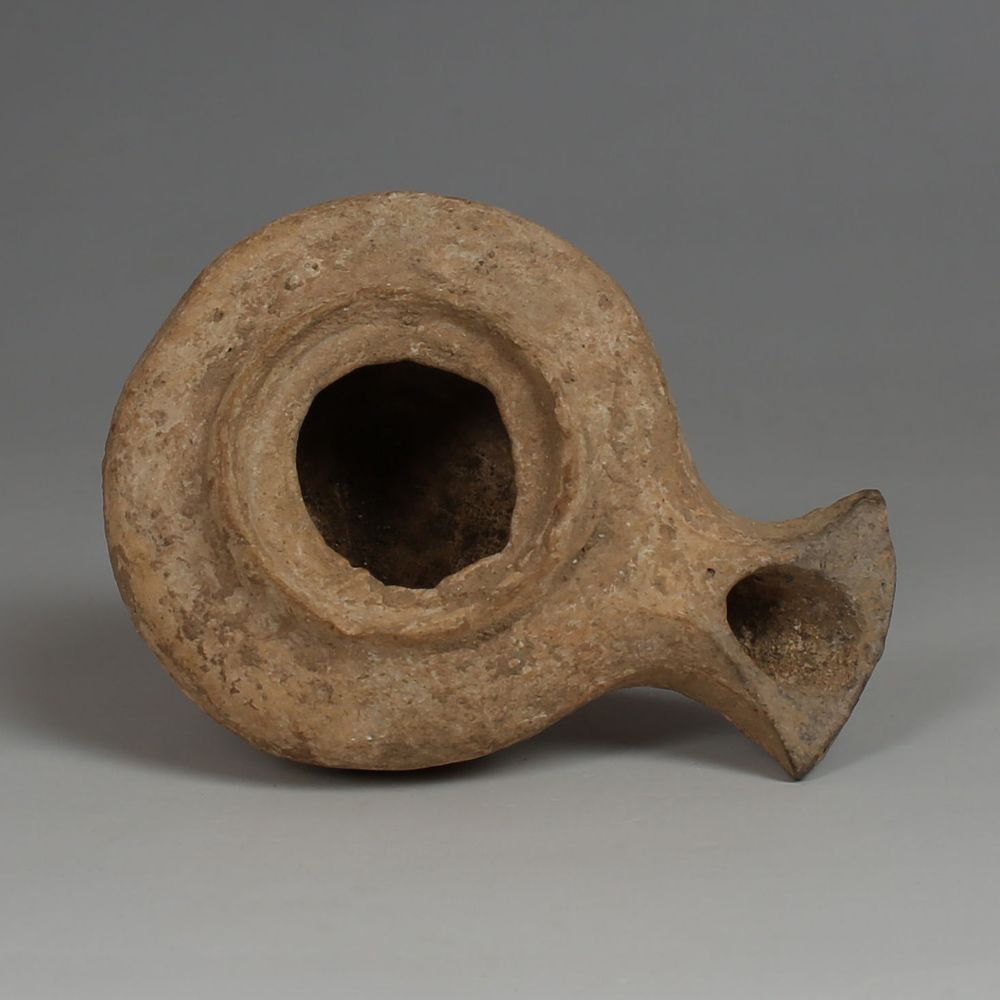
Leilão Bidspirit | Roman, Herodian oil lamp, Type
Roman, Herodian oil lamp, Type Kennedy 3, Hadad 4 - ITEM: Oil lamp, . Type Kennedy 3, Hadad 4 MATERIAL: Pottery CULTURE: Roman, Herodian period PERIOD: 1st Century B.C - 2nd Century A.D DIMENSIONS: 27 mm x 59 mm x 80 mm CONDITION: Good condition PROVENANCE: Ex Jerusalem private collection, acquired between 1970 - 1990 Comes with Certificate of Authenticity and Export Licence. If you are from outside the European Union, we will have to apply for the export licence again for your country, this takes 3 to 5 weeks and has a cost of 5% of the hammer price, this amount will be added to the final invoice. The Herodian period refers to the time during which the Herodian dynasty ruled over Judea, a region in the Roman Empire, from approximately 37 BCE to 70 CE. This period is named after Herod the Great, who was appointed as king of Judea by the Roman Senate in 37 BCE. Herod the Great's reign was marked by extensive building projects, including the expansion of the Second Temple in Jerusalem, which was one of his most notable achievements. Herod's rule is often characterized by his ambitious architectural undertakings, which included fortresses, palaces, and cities, such as Caesarea Maritima, which he established as a major port city and administrative center. Herod's reign was also marked by political and social upheaval. Although he was a skilled administrator and was able to secure significant Roman support, his rule was often contentious. He faced opposition from various Jewish factions and was known for his harsh measures to maintain control, including the execution of perceived threats within his own family. Herod's policies and his efforts to integrate Jewish and Hellenistic cultures created a complex social and political environment in Judea, which sometimes led to tensions with the local population. Following Herod's death in 4 BCE, his kingdom was divided among his sons, who ruled as tetrarchs. This division eventually led to further instability and conflict, with varying degrees of Roman intervention and oversight. The Herodian period ultimately ended with the First Jewish Revolt (66-73 CE), which led to the destruction of the Second Temple in 70 CE and significant changes in the governance of Judea.