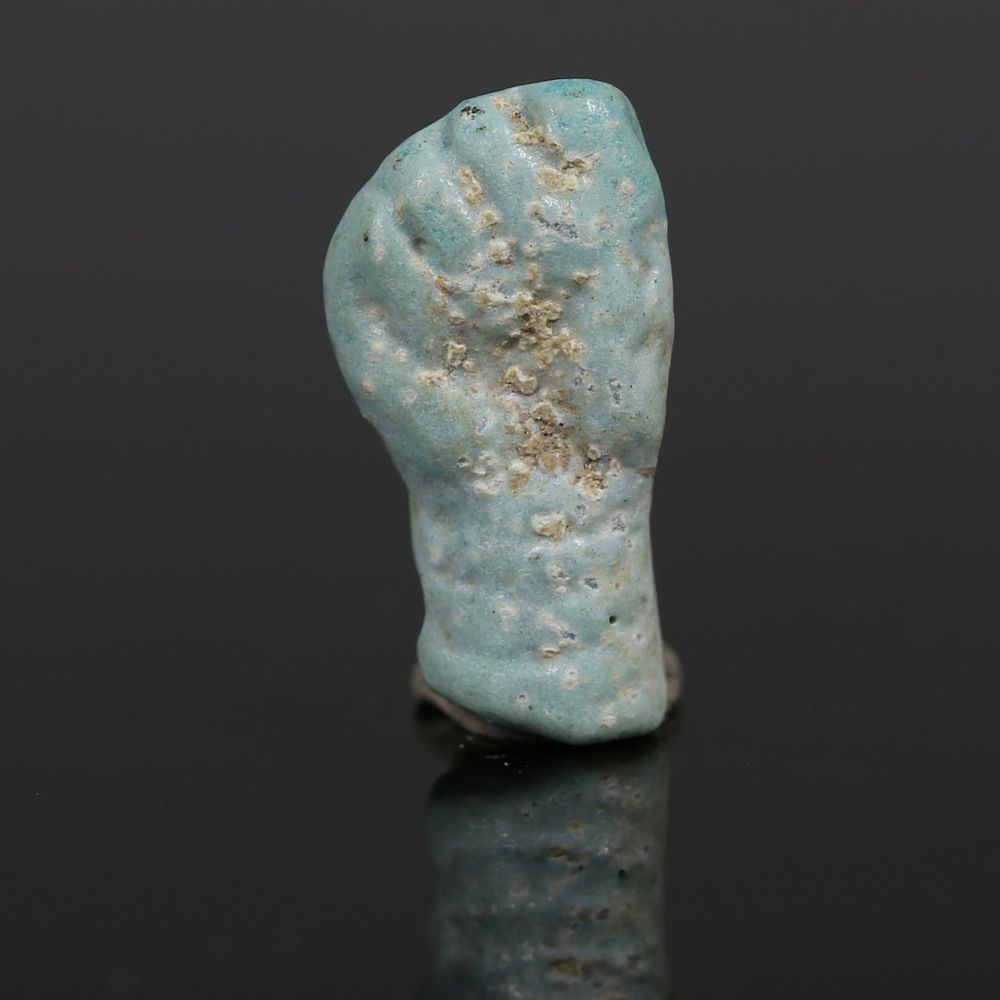
Leilão Bidspirit | Romano-Egyptian votive 'Manu fica' amulet
Romano-Egyptian votive 'Manu fica' amulet - ITEM: Votive 'Manu fica' amulet MATERIAL: Faience CULTURE: Roman PERIOD: 1st - 3rd Century A.D DIMENSIONS: 19 mm x 9 mm CONDITION: Good condition PROVENANCE: Ex Austrian private collection, A.K., acquired between 1970 - 1990 Comes with Certificate of Authenticity and Export Licence. If you are from outside the European Union, we will have to apply for the export licence again for your country, this takes 3 to 5 weeks and has a cost of 5% of the hammer price, this amount will be added to the final invoice. The fig sign is a mildly obscene gesture used at least since the Roman Age in Italy and Southern Europe and parts of the Mediterranean region, including in Turkish culture, and has also been adopted by Slavic cultures. The gesture uses a thumb wedged in between two fingers. This gesture is most commonly used to ward off the evil eye, insult someone, or deny a request. In ancient Rome, the fig sign, or manu fica, was made by the pater familias to ward off the evil spirits of the dead as a part of the Lemuria ritual. The Lemuralia or Lemurian festival is the name given to a pagan religious celebration of the ancient Romans, in which they performed apotropaic rites for three days and nights to exorcise the ghosts of the restless dead and prevent them from haunting their homes. The description of the ceremony or domestic liturgy carried out in these days by the Roman citizens was given by the Latin poet Ovid in his Fasti: the pater familias would walk barefoot through the house at midnight and make an offering of black beans that he would throw behind his shoulder without turning or looking back, making a fig or chestnut as a defence spell (digitis medio cum pollice iunctis), while he noticed a bronze jug, pot or pot and pronounced the formula: Manes exite paterni! / ”Come out, spirits of the ancestors”, in a completely apotropic context. During the days of this festival, the ghosts of the restless dead (called larvae or lemurs, and sometimes umbrae, immagines, species), who could not find rest because they had died a tragic, violent or suicidal death and could disturb the sleep of the living and show themselves at night, were also appeased with offerings of grain and the vestals prepared to offer them the mola salsa, a coarse flour cake with salt made from the first ears of wheat harvested in the season. During these days, considered to be a bad omen, weddings were forbidden (from which the proverb Mense Maio malae nubunt / ”The bad girls got married in May”); moreover, all the temples were closed and at night large pots or bronze cymbals were constantly beaten.